Publications

Selected recent publications from our group.

A physics-informed neural network (PINN)-based model investigation for hydrodynamics and conversion in a gas-solid fluidized bed reactor
Powder Technology · 2025

A physics-informed neural network (PINN)-based model investigation for hydrodynamics and conversion in a gas-solid fluidized bed reactor

L Feng, Z Deng, D Chaffart*, Y Yuan*, J Zhu

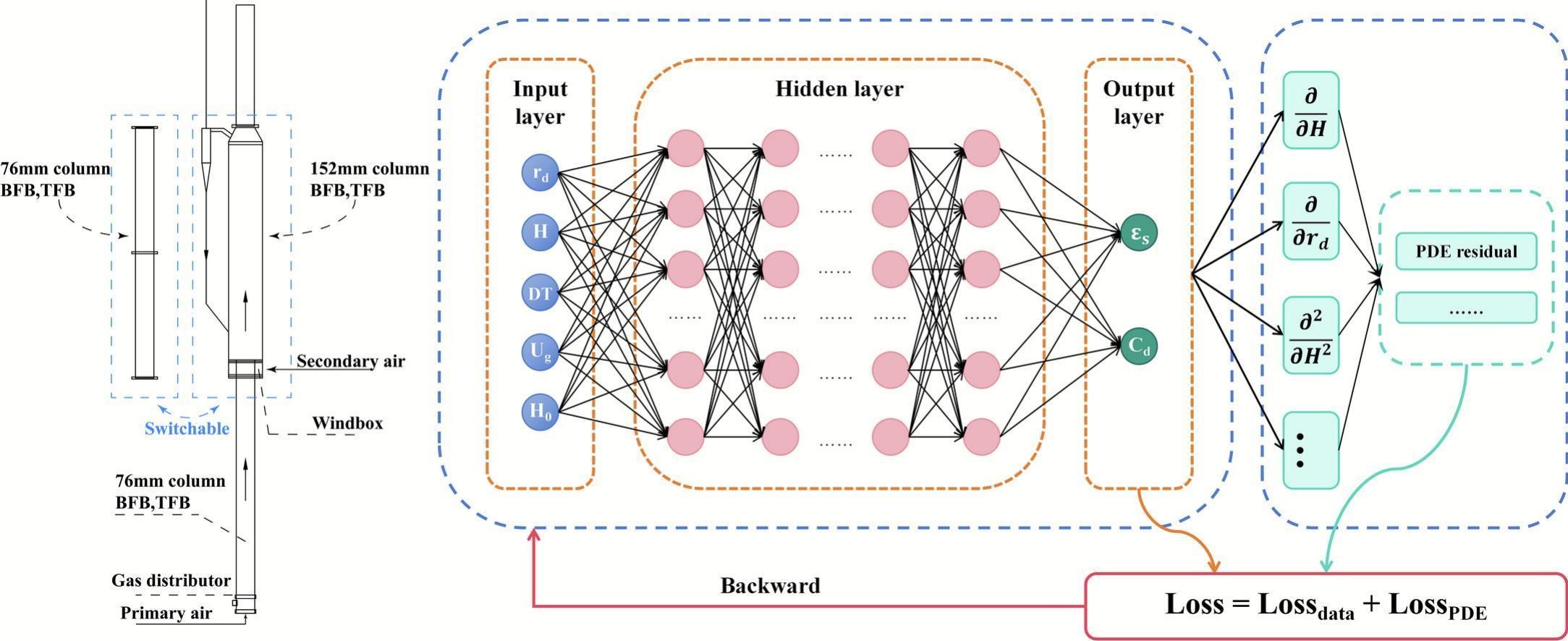
In the field of catalysis, the gas-solid fluidized bed has become the reactor of choice for processes such as ozone decomposition due to its highly efficient heat and mass transfer properties. To demonstrate the intrinsic impacts and generate high-quality predictions for this fluidization system, it is necessary to develop an efficient correlation model between the diverse impacting factors and the reactor fluidization performance. To enhance the applicability of the model and reduce its dependence on experimental data quality, a Physics-informed Neural Network (PINN) is employed in this study to model the catalytic decomposition of ozone in a gas-solid fluidized bed. In addition to the experimental data, the PINN was trained using an ozone transport equation derived in this work for the fluidization system. The experimental data was divided to train and test the PINN model, and the resulting model was compared with traditional, purely data-driven artificial neural networks. The results indicated that the PINN model's predictions maintained a greater consistency with the rational laws due to the introduced physical constraints, while still ensuring high consistency with the experimental observations. Compared to traditional models, the PINN model is more robust and less impacted by the quality of the experimental data. The introduced physical bias was proved to enhance the model's generalization capability and interpretability. The importance of incorporating physical bias in developing high-quality machine learning models is highlighted for performance prediction in fluidization systems. It underscores the need for continued efforts to advance physics-informed machine learning methods in engineering.
Time-series signal analysis of sustainable process intensification: Characterization method development of gas-solid fluidized bed hydrodynamics towards AI-enhanced algorithms
Green Energy and Resources · 2025

Time-series signal analysis of sustainable process intensification: Characterization method development of gas-solid fluidized bed hydrodynamics towards AI-enhanced algorithms

Y Yuan, S Chen, M Li, J Zhu, L Feng, T Zhang, K Wu*, D Chaffart*

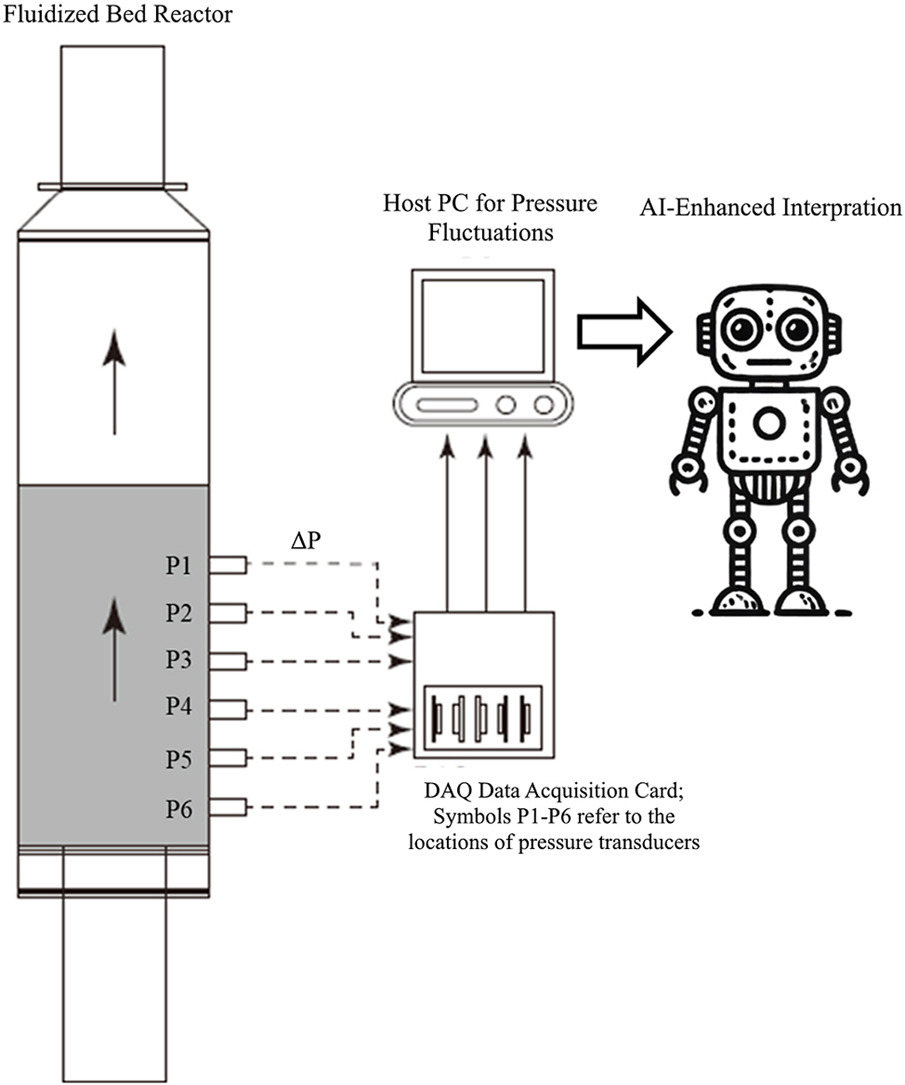
Sustainable manufacturing is pivotal to promoting societal advancements that balance the progressive growth of human needs with the gradual exhaustion of natural resources and the environmental impact of current manufacturing technologies. Gas-solid fluidization, a key process intensification technique, has advanced sustainability for over a century. The complex nature of these systems has led to numerous analysis algorithms for assessing time-series signals critical to observe the fluidization hydrodynamics. This work reviews widely used signal analysis methods for processing the commonly-measured time-series signals for fluidization, specifically focusing on pressure drop and optical signals. Despite their widespread implementation, these methods have limited potential due to the limited visibility of optical signals and the inability of pressure signals to provide localized fluidization system information. Veritably, the traditional algorithms cannot consider all influencing factors and handle flawed, large-scale signals.

Artificial intelligence (AI) has emerged as a promising solution to overcome these limitations. Nevertheless, AI-enhanced methods for fluidization signal analysis are still nascent. This work emphasizes the potential of AI to enhance understanding of complex fluidization behavior, particularly heterogeneous agglomerations, through reviewing signal analysis methods from traditional numerical methods to AI-driven approaches. Furthermore, this study highlights the future steps necessary to adequately expand upon machine learning-based analysis methodologies and extends a call to arms for future research establishment within this field. These advancements will support the development of sustainable manufacturing technologies that balance industrial progress with environmental responsibility.

Polynomial Neural Networks for improved AI transparency: An analysis of their inherent explainability (operational rationale) capabilities
Digital Chemical Engineering · 2025

Polynomial Neural Networks for improved AI transparency: An analysis of their inherent explainability (operational rationale) capabilities

D Chaffart*, Y Yuan*

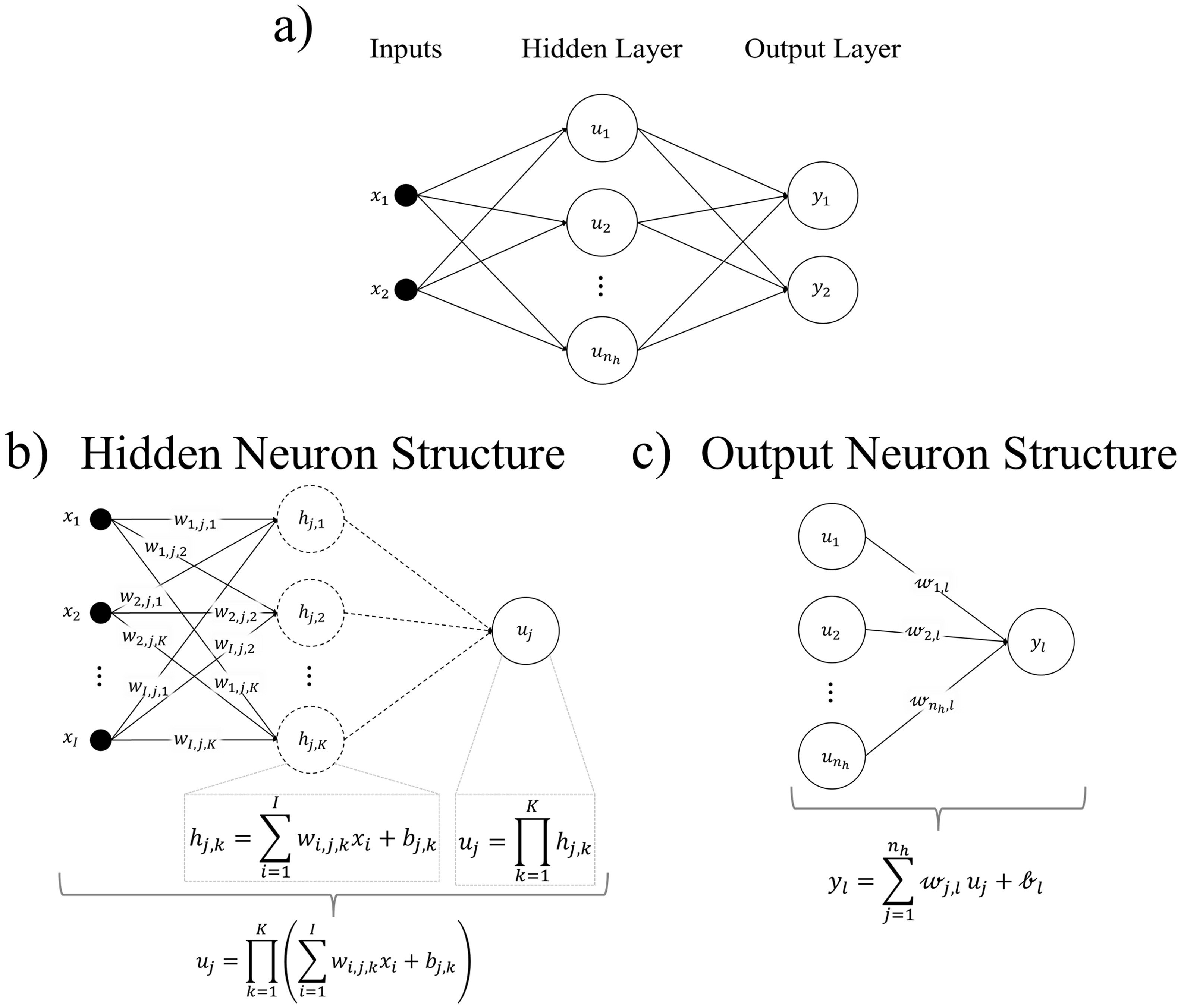
The demand for reliable Artificial Intelligence (AI) models within critical domains such as Chemical Engineering has garnered significant attention towards the use and development of transparent AI methodologies. Nevertheless, the field of AI transparency has received an uneven level of attention, such that crucial aspects like explainability (i.e., the transparency of the AI's operational rationales) have remained understudied. To address this challenge, this study investigates the inherent explainability capabilities of Polynomial Neural Networks (PNNs) for applications within Chemical Engineering. PNNs, which implement higher-order polynomials in lieu of linear expressions within their hidden layer neurons, are inherently nonlinear, and thus do not require an activation function to accurately capture the behavior of a system. Accordingly, these neural networks provide continuous, closed-form algebraic expressions that can be used to ascertain the contributions of individual features in the AI architecture towards the network operational behavior. In order to study this behavior, the PNN method was adopted in this work to capture the relationships of noiseless and noisy data derived according to simple mathematical expressions. The PNN polynomials were then extracted and examined to highlight the insights they provide regarding the system operational rationales. The PNN method was furthermore applied to capture the behavior of a circulating fluidized bed reactor to fully showcase the explainative capability of this method within a Chemical Engineering application. These studies highlight the intrinsic explainability capabilities of PNNs and demonstrated their potential for reliable AI implementations for applications in Chemical Engineering.

Transparency: the missing link to boosting AI transformations in chemical engineering
Engineering · 2024

Transparency: the missing link to boosting AI transformations in chemical engineering

Y Yuan, D Chaffart, T Wu, J Zhu*

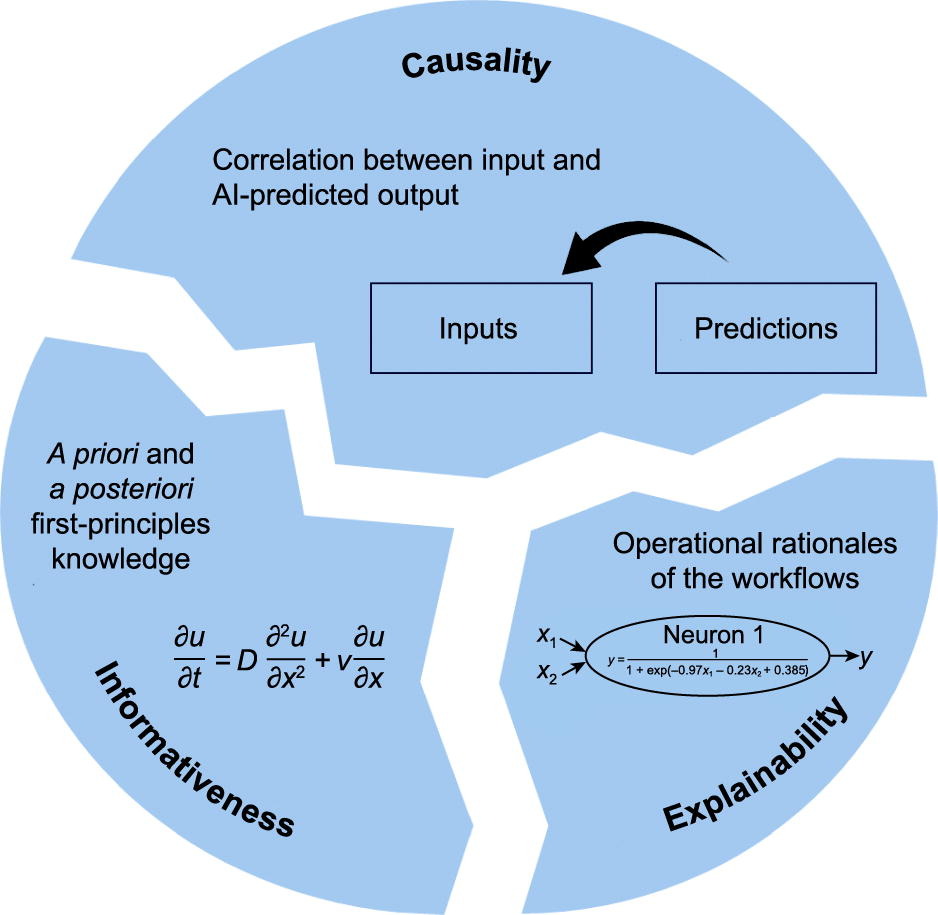
The issue of opacity within data-driven artificial intelligence (AI) algorithms has become an impediment to these algorithms’ extensive utilization, especially within sensitive domains concerning health, safety, and high profitability, such as chemical engineering (CE). In order to promote reliable AI utilization in CE, this review discusses the concept of transparency within AI utilizations, which is defined based on both explainable AI (XAI) concepts and key features from within the CE field. This review also highlights the requirements of reliable AI from the aspects of causality (i.e., the correlations between the predictions and inputs of an AI), explainability (i.e., the operational rationales of the workflows), and informativeness (i.e., the mechanistic insights of the investigating systems). Related techniques are evaluated together with state-of-the-art applications to highlight the significance of establishing reliable AI applications in CE. Furthermore, a comprehensive transparency analysis case study is provided as an example to enhance understanding. Overall, this work provides a thorough discussion of this subject matter in a way that—for the first time—is particularly geared toward chemical engineers in order to raise awareness of responsible AI utilization. With this vital missing link, AI is anticipated to serve as a novel and powerful tool that can tremendously aid chemical engineers in solving bottleneck challenges in CE.

Multiscale physics-informed neural network framework to capture stochastic thin-film deposition
The Journal of Physical Chemistry C · 2024

Multiscale physics-informed neural network framework to capture stochastic thin-film deposition

D Chaffart, Y Yuan, LA Ricardez-Sandoval

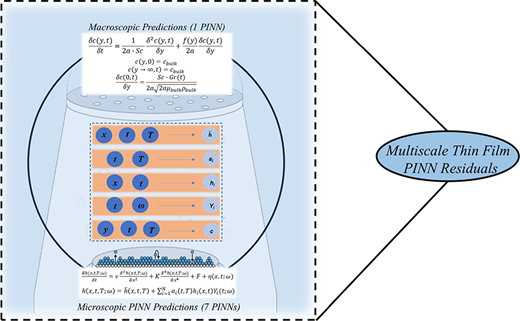
This work outlines the development of a multiscale Physics-Informed Neural Network (PINN) approach to capture the full multiscale thin-film growth process within a stagnation point flow vapor deposition chamber. These PINNs were trained using a multiscale model consisting of a macroscale mass transport partial differential equation (PDE) that captures the gaseous precursor species movement coupled with a microscale stochastic PDE (SPDE) to capture the film surface growth. Both the macroscale and microscale differential expressions were embedded directly within the loss function so that all intercommunication between the two scales could be directly accounted for within the PINN. Furthermore, the SPDE was subjected to series expansions and diagonally orthogonal decomposition to embed it within the PINNs despite the stochasticity. The fully trained multiscale PINNs were validated via comparison to the standard kMC-based multiscale model used to capture thin-film deposition processes. Overall, this work demonstrates the potential of PINNs to capture the entire stochastic behavior of an intercommunicating multiscale system in the presence of molecular-level stochastic variability, which has not been explicitly addressed previously in the literature. Furthermore, they illustrate the significant computational efficiency of the multiscale PINNs, which were orders of magnitude faster than the kMC-based and SPDE-based multiscale models.